

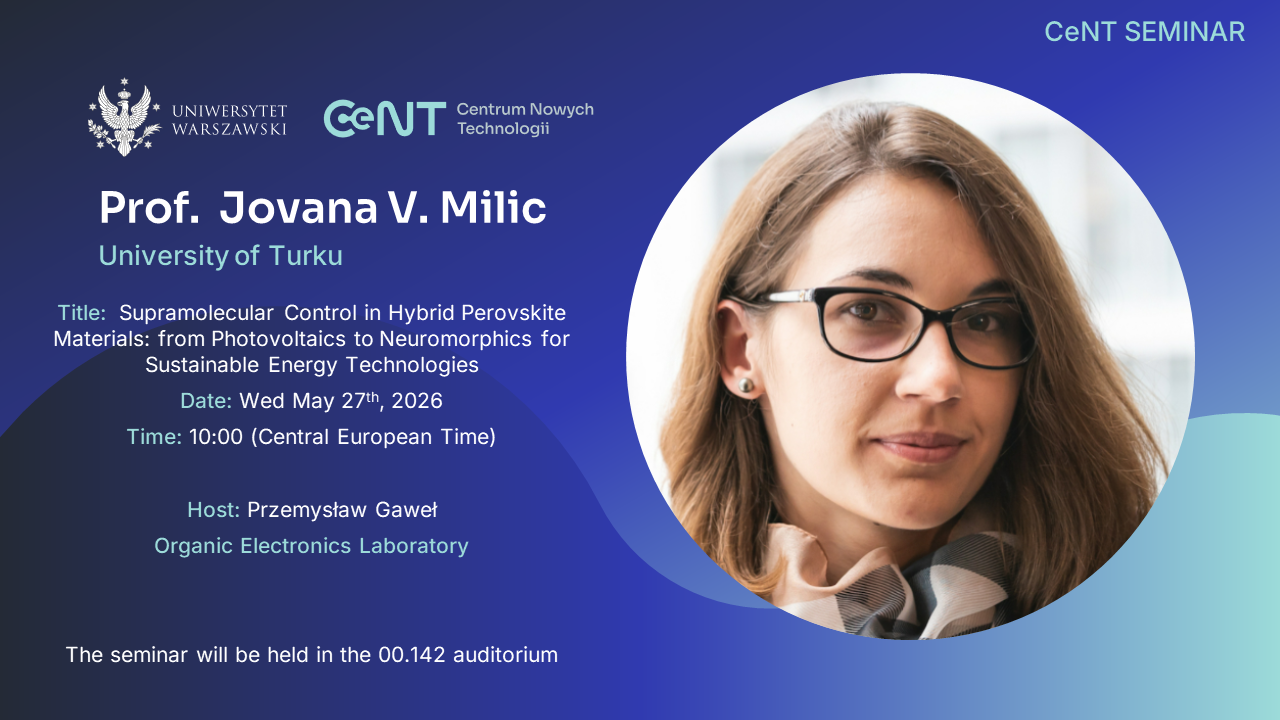
Seminarium CeNT (Śr., 27 Maja, 2026, 10:00): Supramolecular Control in Hybrid Perovskite Materials: from Photovoltaics to Neuromorphics for Sustainable Energy Technologies
22 05 2026
Kategoria: Seminaria CeNT, Strona główna
Centrum Nowych Technologii Uniwersytetu Warszawskiego zaprasza na seminarium::
prof. Joavana V. Milic
Unversity of Turku, Finland
Tyuł: Supramolecular Control in Hybrid Perovskite Materials: from Photovoltaics to Neuromorphics for Sustainable Energy Technologies
Data: Środa, 27 maja, 2026
Czas: 10:00
Prowadzący: dr Przemysław Gaweł
Seminarium odbędzie się w audytorium 00.142 w CeNT, Banacha 2c
Abstrakt:
Hybrid organic-inorganic framework materials have emerged as one of the most promising semiconductors in optoelectronics.[1] In particular, hybrid halide perovskite materials have demonstrated superior solar-to-electric energy conversion in photovoltaics. These are soft yet crystalline mixed ionic-electronic semiconductors with remarkable optoelectronic characteristics.[2,3] However, their limited stability in response to environmental factors, such as oxygen and moisture, as well as under operating conditions of voltage bias and light, hamper practical applications.[4] This is the result of ion migration that contributes to the reactivity at the interface, limiting stability under device operating conditions.[2] There has been an effort to overcome these shortcomings by developing tailored organic components that template hybrid perovskite frameworks and contribute to their stabilization through increased hydrophobicity and limited ion permeability, enhancing their performance in optoelectronics.[5,6]
We demonstrate the capacity to rely on supramolecular engineering to develop a new generation of hybrid perovskite materials that respond to external stimuli and adapt to their operating conditions, such as by incorporating photochromic systems into ‘smart solar cells’ that can adapt to day-night cycles.[7] The dynamic control of the underlying ionic migration has set the basis for the utility of these materials in brain-inspired memory elements, as artificial synapses,[8] and self-powered memories for neuromorphic computing,[9] revealing new perspectives for hybrid framework materials, and more sustainable lead-free systems,[10] in emerging technologies.
Bibliografia:
[1] S. Krause, J. V. Milić*, Commun. Chem. 2023, 6, 151.
[2] J. Thiesbrummel, J. V. Milić, C. Deibel, E. C. Garnett, S. Tao, T. Kirchartz, A. Guerrero, P. Cameron, W. Tress, M. Saiful Islam, B. Ehrler, Nature Rev. Chem. 2026, in press.
[3] L. A. Muscarella, J. V. Milić*, et al. Adv. Mater. 2022, 34, 202108720.
[4] J. V. Milić*, J. Mat. Chem. C 2021, 9, 11428.
[5] W. Luo, G. AlSabeh, J. V. Milić*, in Photochemistry (Eds.: S. Crespi, S. Protti), 2022, 50, 346–370.
[6] G. AlSabeh, M. Grätzel, J. V. Milić*, et al. Angew. Chem. Int. Ed. 2025, e202417432.
[7] W. Luo, J. V. Milić*, et al. Adv. Mater. 2025, 2420143.
[8] M. M. Ganaie, G. Bravetti, S. Sahu, M. Kumar, J. V. Milić*, Mater. Adv. 2024, 5, 1880.
[9] M. Loizos, K. Rogdakis, W. Luo, P. Zimmermann, A. Hinderhofer, J. Lukić, M. Tountas, F. Schreiber, J. V. Milić*, E. Kymakis*, Nanoscale Horiz. 2024, 9, 1146.
[10] (a) M. Zhu et al., Chem. Soc. Rev. 2025, 54, 11719; (b) Adv. Energy Sust. Res. 2025, 2500028; (c) M. Ghasemi, et al. Adv. Energy Mater. 2025, 2502693; (d) L. A. Muscarella et al. Mater. Horiz. 2025, 12, 6124–6132; (e) M. M. Ganaie et al. Mater. Horiz. 2026, in press.