


Seminarium CeNT (piątek, 10 kwietnia 2026): Decoding the dark matter of genomes: chromatin loop memory connects regulatory variation to disease and evolution
07 04 2026
Kategoria: Seminaria CeNT, Strona główna
Centrum Nowych Technologii Uniwersytetu Warszawskiego zaprasza na seminarium:
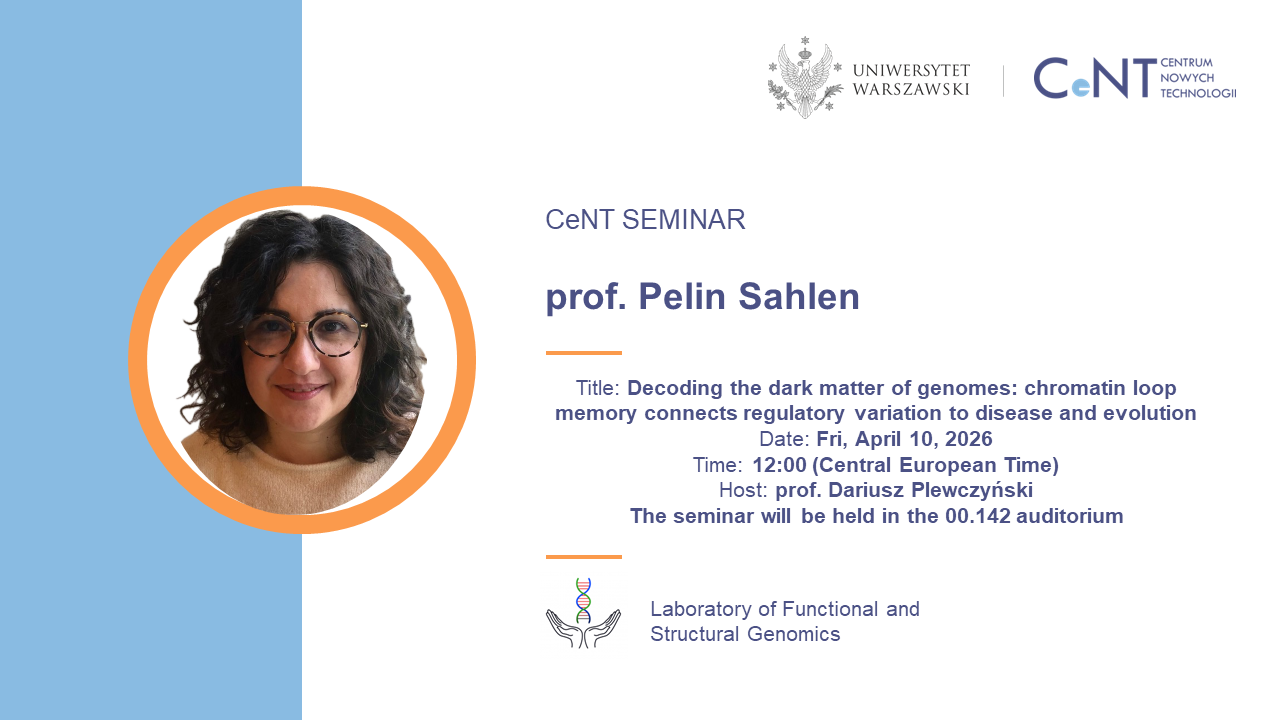
prof. Pelin Sahlén
KTH Royal Institute of Technology, Stockholm, Sweden
Tytuł: Decoding the dark matter of genomes: chromatin loop memory connects regulatory variation to disease and evolution
Data: Friday, April 10, 2026
Czas: 12:00 (Central European Time)
Prowadzący: prof. Dariusz Plewczyński
Seminarium odbędzie się w audytorium 00.142 w CeNT (Banacha 2C)
Abstrakt:
In this talk, I will present our recent work demonstrating that chromatin loop memory can be leveraged to identify functional regulatory mutations in the non-coding genome. In our first study, we performed capture Hi-C on ascending aorta samples from 16 individuals, including eight patients with bicuspid aortic valve (BAV). By integrating whole-genome sequencing and spatial transcriptomics data from fetal hearts with enhancer–promoter interaction maps, we show that the etiology of BAV is far more complex than previously appreciated. We identify tens of rare regulatory variants per patient that converge on a small number of genes with critical roles in valve development. In our second study, we compare enhancer–promoter interactomes and transcriptomes between brain tissues from mongrel dogs and European wolves to investigate the role of regulatory rewiring in rapid adaptation. We uncover extensive enhancer–promoter rewiring in dogs, predominantly affecting evolutionarily older genes and genes involved in neurodevelopment. Despite these changes, gene expression levels remain largely stable, supporting a model in which alternative enhancer usage enables adaptation through rewiring of regulatory networks without disrupting transcriptional output. Together, these results support a model in which chromatin loops established during development persist across cell states but are selectively activated at specific time points. This “chromatin loop memory” provides a framework for functional annotation of the non-coding genome and links regulatory variation to both disease and evolution.