


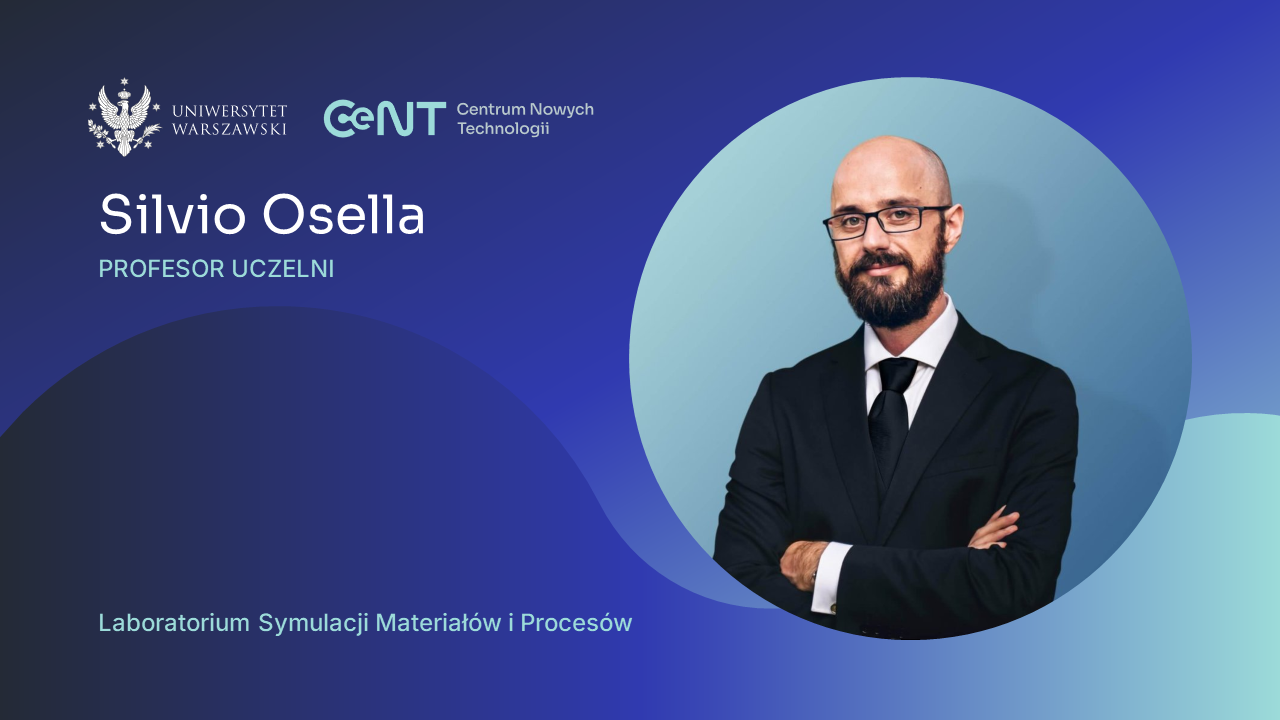
Silvio Osella promoted to a university professor position
29 05 2026
Category: CeNT news, Main page
We are dhappy to announce that at its meeting on May 20, 2026, the Senate of the University of Warsaw decided to appoint Dr. Silvio Osella, head of the Materials and Processes Simulation Laboratory at the Centre of New Technologies, as a university professor.
Silvio Osella started to work at CeNT UW on 2017 as a NCN POLONEZ fellow. Previously, Dr. Osella was a postdoctoral fellow at Theoretical Chemistry & Biology Laboratory, KTH (Sweden), founded by Center for Quantum Materials and Nordita in 2016 and at the Laboratory of Chemistry of Novel Materials, University of Mons (Begium) in 2015. Ge holds a Master Degree in Chemistry from the University of Torino (Italy) and a PhD in Chemistry from University of Mons (Begium). He has been a recipient of several grants, like POLONEZ, SONATA, OPUS and SONATA BIS from NCN and the BEKKER grant from NAWA. He supervised several master students and two postdocs. He was awarded the Rector’s award for “Extraordinary scientific achievements, considered as the breaking through in the discipline and contributing significantly to the prestige of the society, thus increasing the reputation of our University (University of Warsaw)” for two consecutively years (2020-2021) and the Ministry of Science and Higher Education competition for the Minister’s Scholarship “For young, outstanding scientists under 35 conducting high-quality research with impressive international academic records”, Poland, granted for the 2019-2021 period.
The main area of research of the Materials and Processes Simulation sLaboratory focuses on the use of computational chemistry to study the opto-electronic, transfer and transport properties of low-dimensional materials by means of a multiscale computational approach, in which different computational methods are combined together to properly assess the complexity of the studied systems. In particular, th group is interested in (1) multiscale modelling of novel 2D functional materials for organic electronic applications (such as photovoltaics, OLED and OFET) with a focus on charge and energy transfer and transport at interfaces of different dimensionalities (i.e. 0D/2D, 2D/2D, 1D/2D, 0D/1D). 2) heterogeneous catalysis with focus on electrochemical, photochemical and photo(electro)chemical reactions for the reduction of harmful gases to high value chemicals. (3) (non)-linear and fluorescent optical properties of fluorescent molecules in biological environments like lipid bilayer membranes and proteins. (4) method development oriented towards application of well known principles to low dimensional materials.
We extend our heartfelt congratulations and wish them every success and many scientific achievements!