


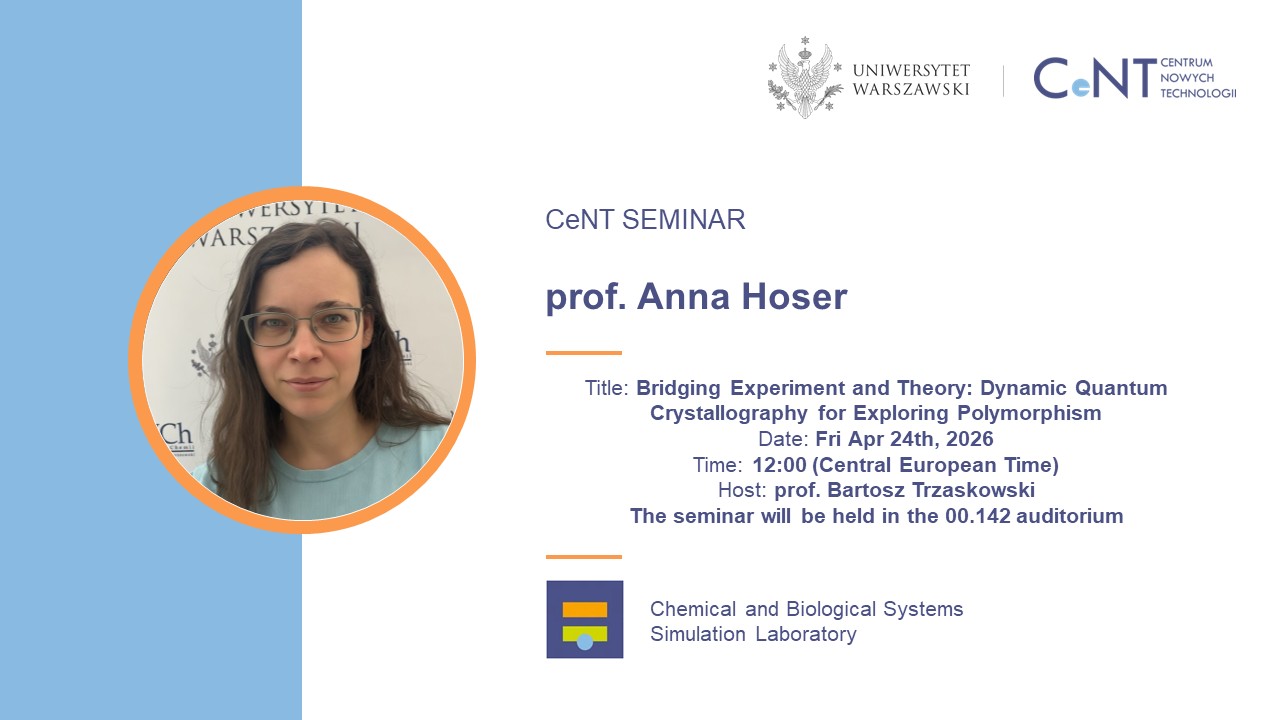
CeNT Seminar (Friday, April 24, 2026): Bridging Experiment and Theory: Dynamic Quantum Crystallography for Exploring Polymorphism
20 04 2026
Category: CeNT seminars, Main page
The Centre of New Technologies, University of Warsaw invites to a seminar by:
dr. Anna Hoser
Faculty of Chemistry, University of Warsaw
Title: Artificial enzymes based on metal oxo-clusters: from discrete species to metal–organic frameworks
Date: Friday, April 24, 2026
Time: 12:00 (Central European Time)
Host: prof. Bartosz Trzaskowski
The seminar will be held in the 00.142 auditorium, Banacha 2c
Abstract:
Polymorphism—the ability of a compound to exist in at least two different arrangements of the molecules of that compound in the solid state—remains one of the key challenges in understanding the structure–property relationships of molecular materials.1 Different polymorphic forms may differ significantly in solubility, stability, mechanical behaviour, or thermodynamic properties, making the identification of the most stable form and the prediction of potential undiscovered structures an essential yet difficult task. These difficulties arise not only from the subtle energetic differences between polymorphs, but also from the need to accurately account for lattice dynamics and entropy, which remain challenging for purely theoretical approaches.
In this talk, I will present the Normal Mode Refinement (NoMoRe) method2-4, developed by us, in which selected vibrational mode frequencies obtained from periodic DFT calculations are refined directly against high-quality single-crystal X-ray diffraction data. This approach allows us to obtain highly accurate anisotropic displacement parameters (ADPs), including for hydrogen atoms, and enables the reliable extraction of thermodynamic properties such as heat capacities and entropies for molecular crystals—quantities that remain difficult to compute with sufficient precision using theoretical methods alone. By refining vibrational contributions against experimental data, NoMoRe effectively bridges computational models and real crystal behaviour, offering a unique route to quantifying subtle energetic differences between polymorphs.
By merging theory and experiment, we aim to achieve a deeper, quantitatively accurate understanding of the stability and energetic landscape of molecular crystals. I will present case studies—including the pharmaceutical polymorphs pyrazinamide5 and piracetam, the jumping crystal L-pyroglutamic acid6, and related systems—illustrating how dynamic quantum crystallography provides new insights into polymorphism, supports crystal-structure
prediction efforts, and helps bridge the long-standing gap between computational models and experimentally observed crystalline forms. Finally, I will pinpoint new directions of our developments (initial models from machine learning potential for NoMoRe) and I will discuss several molecular crystals that continue to challenge current computational methods, highlighting where further methodological development is needed.
[3] A. A. Hoser, M. Sztylko, D. Trzybiński and A. Ø. Madsen, ChemCommun., 2021, 57, 9370- 9373. [4] H. Butkiewicz, M. Chodkiewicz, A. Ø. Madsen, A. A. Hoser, 2025 IUCrJ, 12, 123-136
[5] A. A. Hoser, T. Rekis, A. Ø. Madsen, Acta Crystallographica Section B, 2022, 78, 416-424 [6] A. A. Hoser, T. Rekis, H. Butkiewicz, K. Be̅rziņš, A. S. Larsen, A. Bosak, B. J. Boyd, A. Madsen, 2025, Cryst.Growth Des. 25, 3, 593–602