
Flows – at the intersection of biology, technology, and art
03 03 2026
Category: CeNT news, Main page
Flows is the first installment of the Monolith series—a search for new post-human matter and, at the same time, an exhibition by Kuba Bąkowski that unfolds over time. The artist is creating a kind of biolaboratory at the Ujazdowski Castle Centre for Contemporary Art. The central element of the work is a bioreactor, transformed into a capillary, kinetic form of ambiguous status—at once sculpture and research apparatus.
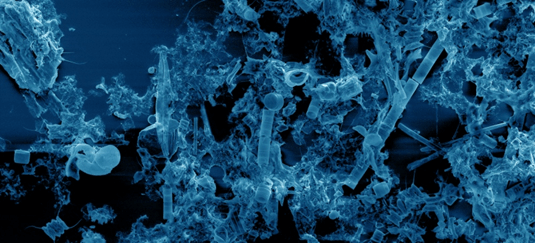
The point of departure for the work was research conducted in collaboration with Prof. Joanna Kargul, who heads the Solar Fuels and Photosynthesis Laboratory at the Centre of New Technologies, University of Warsaw. The project employs single-celled algae, including the extremophilic red alga Cyanidioschyzon merolae—a representative of an early evolutionary lineage within the phylum Rhodophyta—as well as green algae of the phylum Chlorophyta, widely used as model organisms in phototaxis research. Their capacity to respond to light and to move spontaneously through a water column becomes both creative material and medium, as well as a field for investigating the relationships between living organism, technology, and environment.
The project explores the potential of algae as living matter—not only dynamic, adaptive, and capable of functioning under shifting environmental conditions—but also as an alternative, autonomous regenerative system. In this framing, algae open the way to speculative visions of the future—a world without, or after, the human. Their metabolic, photosynthetic, and transformative capacities allow us to imagine scenarios in which biological matter assumes structural, energetic, and processing roles within a post-human landscape.
The resulting biosculpture functions as a prototypical habitat for algal colonies. Its elements respond to light intensity, generating a dynamic system of energy flows between biological matter, steering algorithms, and the architecture of the object. In this way, the artist continues his long-standing interest in biohybrids—sculptures in which movement and behavior arise from the interplay of metabolic processes and digital systems.
The project also opens a space for broader reflection on the persistence of matter across geological and biological time. The accompanying program includes performative lectures and talks in which researchers will discuss, among other topics, the microorganisms inhabiting Warsaw’s water bodies, the life of extremophiles—organisms capable of thriving in extreme environmental conditions—in volcanic hot habitats, and the iron-oxidizing bacteria that reduce metal to brittle rust. It is precisely these microorganisms that are responsible for the slow, inexorable degradation of metal structures such as the wreck of RMS Titanic. The ship’s hull is currently being colonized by bacterial communities that are converting its steel into friable ore. Within a few decades, the wreck will be almost entirely absorbed into the natural cycle of matter—a testament to how human-made objects can transform into new geologico-biological forms.
The Flows installment can be visited until the end of March at the Ujazdowski Castle Centre for Contemporary Art, see: https://u-jazdowski.pl/program/wystawy/-monolit-/przeplywy-/przeplywy-panel-dyskusyjny
