CeNT Seminar (Wed Feb 4th, 2026): Erosion of Scientific Integrity Fueled by Quantitative Evaluation Metrics
28 01 2026
Category: CeNT news, CeNT seminars, Main page, Science news
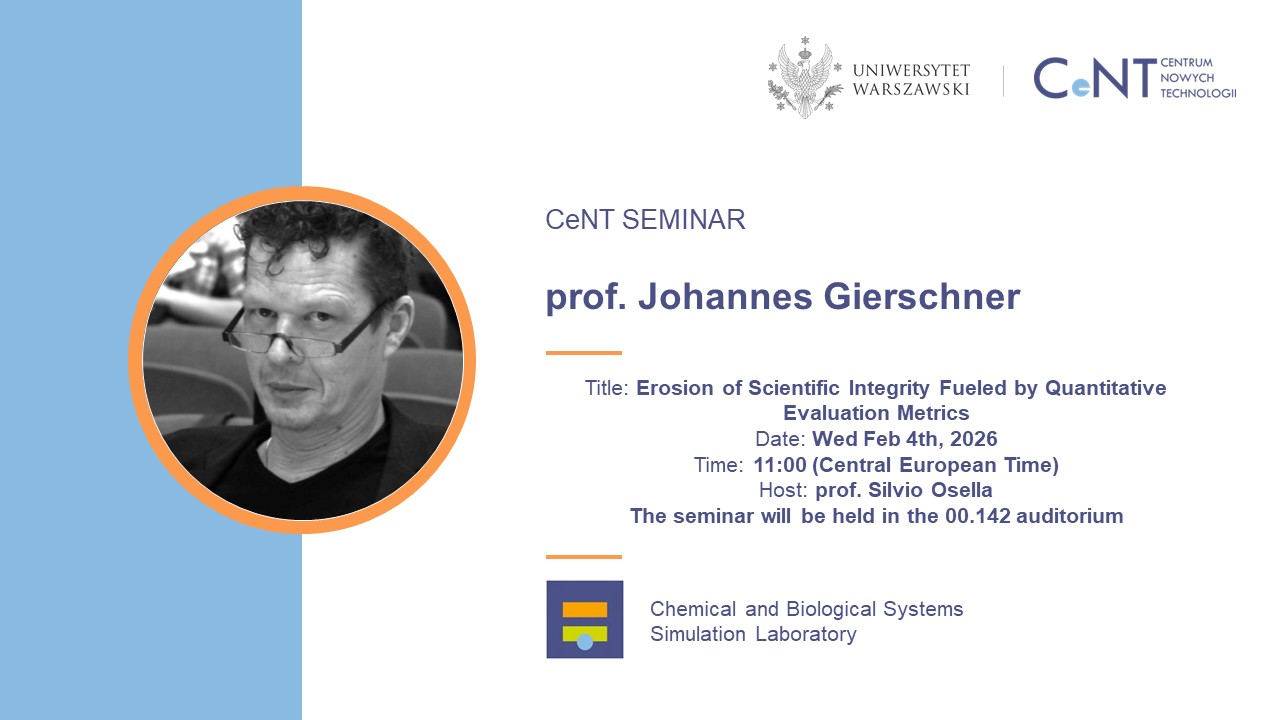
The Centre of New Technologies, University of Warsaw invites to a seminar by:
prof. Johannes Gierschner
Madrid Institute for Advanced Studies, IMDEA Nanoscience, Madrid, Spain
Title: Erosion of Scientific Integrity Fueled by Quantitative Evaluation Metrics
Date: Wed Feb 4th, 2026
Time: 11:00 (Central European Time)
Host: prof. Silvio Osella
The seminar will be held in the 00.142 auditorium
Abstract:
In the last few years, the scientific community has been increasingly concerned by malpractice behavior, which does not fit the classic description of ‘scientific misconduct’ (summarized as ‘falsification, fabrication, plagiarism’ – FFP[1]). Nevertheless, these practice appear to be not less threatening to the community as they come as a steady erosion, now evolving into a landside. This concerns in particular ‘CV polishing’ by ‘citation gaming’ through excessive ‘guest’- & ‘hyper’-authorships and ‘citation cartels’,[2] not only threatening the ‘scientific currency’ of reputation, but likewise assaulting the business model of data suppliers. In fact, a total of staggering 35% of the researchers were (increasingly) removed from 2021 to 2024 from Clarivate’s ‘highly cited researcher’ (HCR) list due to violation of scientific integrity.[3] The reason for this sharp increase in malpractice can be directly related to metrics-based quantitative evaluation,[4] concerning both institutions and individual researchers. In fact, this follows perfectly – and frighteningly – Goodhart’s law, which, applied to the current context, may read as ‘all metrics of scientific evaluation are bound to be abused’.[5]
The seminar puts ‘citation gaming’ into the limelight, showing that malpractice behavior depends on whether the individual researcher stands on the top or the bottom of the scientific food chain. While researchers at the bottom are obliged to pimp up their CV by becoming prey to paper mills and predatory journals & conferences (all at public cost), as well as by excessive self-citation and creating national (‘inclusive’) ‘citation cartels’,[2] researchers at the top may follow more sophisticated measures, blessed by the ‘Matthew effect’.[6] This includes ‘honorary’ or ‘guest’ authorships, elaborated international (‘exclusive’) ‘citation cartels’, and well paid lucrative ancillary revenues like ‘gift affiliations’ in Saudi Arabia, editor positions in predatory journals or decoy organizer & plenary speaker of predatory conferences.[2] Equally, for all researchers, metrics-driven working & thinking fuels scientific hypes with short-term impact and leads to a tsunami of often worthless ‘salami papers’ of questionable content, which nobody is able to digest anymore. The (mostly private) publishers play a disturbing role in this game, fueling hypes and occasionally tolerating citation cartels, all to inflate the (short term) ‘impact’ of their journals; equally they encourage hyper-proliferation ‒ at increasingly low standards, solely to satisfy shareholders’ interests to maximize their already exorbitant profit margins,[7] all on public costs.
We advocate for an end of scientific hyper-proliferation by returning to ‘quality over quantity’ in evaluation and publishing, based on the principles of modesty, integrity & autonomy, and to regain control on the definition of quality and impact, and the modus operandi of scientific communication. Only in doing so, science is able to retrieve its incorruptible voice in times of grand challenges ahead.
References:
[1] see e.g. (a) DFG Guidelines for Safeguarding Good Research Practice; (b) European Code of Conduct for Research Integrity; (c) J. Mehlich, Good Chemistry: Methodological, Ethical, and Social Dimensions, RSC Publishing 2021. [2] for further reading on relevant aspects, see link collection at www.uv.es/jogiers/ethics.html.[3] (a) Clarivate’s 2024 HCR analysis; (b) see e.g. the analysis in El País. [4] see e.g. (a) Declaration on Research Assessment (DORA); (b) Coalition for Advancing Research Assessment (COARA); (c) J. Z. Muller, The Tyranny of Metrics, Princeton University Press 2018. [5] M. Biagioli, Watch out for cheats in citation game, Nature 2016, 535, 201. [6] see e.g. https://en.wikipedia.org/wiki/Matthew_effect. [7] https://en.wikipedia.org/wiki/Elsevier.