

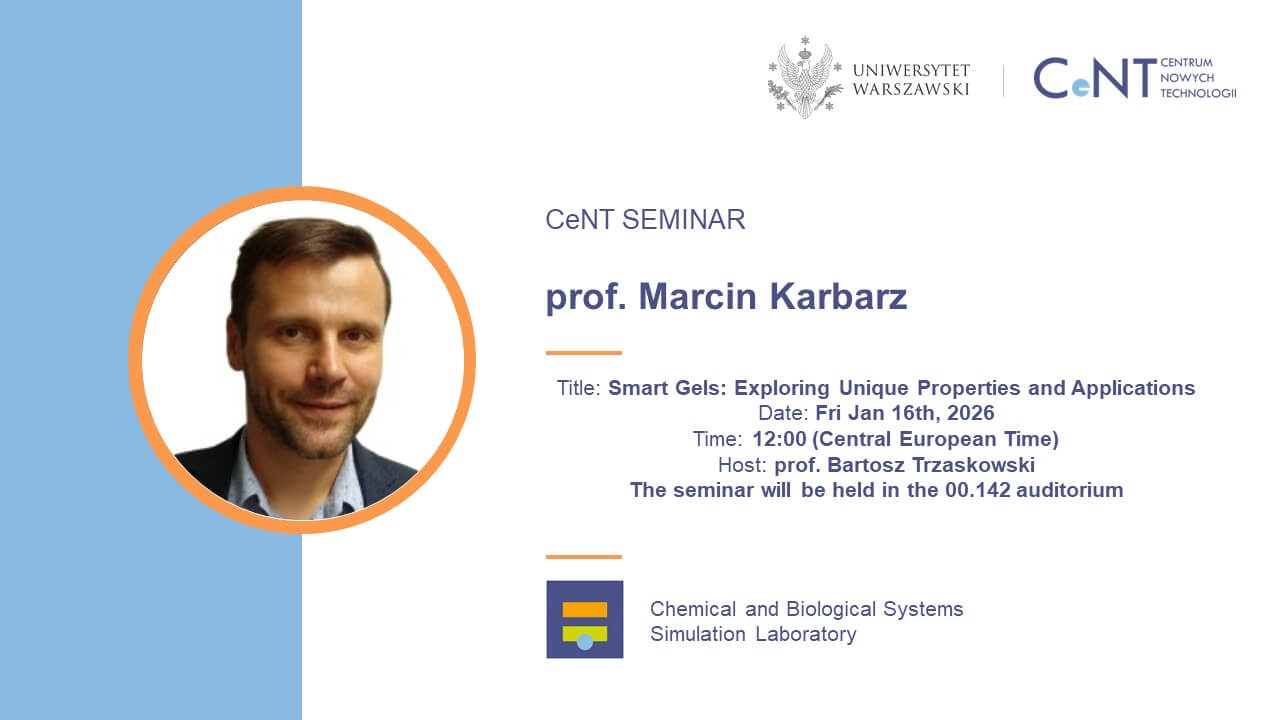
CeNT Seminar (Fri Jan 16th, 2026): Smart Gels: Exploring Unique Properties and Applications
12 01 2026
Category: CeNT news, CeNT seminars, Main page, Science news
The Centre of New Technologies, University of Warsaw invites to a seminar by:
prof. Marcin Karbarz
Faculty of Chemistry, University of Warsaw
Title: Smart Gels: Exploring Unique Properties and Applications
Date: Fri Jan 16th, 2026
Time: 12:00 (Central European Time)
Host: prof. Bartosz Trzaskowski
The seminar will be held in the 00.142 auditorium
Abstract:
Gel materials, due to their unique structure, possess a range of exceptional properties that make them valuable in various applications, including biomedical, environmental, and industrial fields. Some gels are classified as smart materials because of their sensitivity to external stimuli and their ability to self-heal and self-assemble. The volume phase transition phenomenon in gel materials can cause significant reversible changes in volume, shape, and physicochemical properties in response to specific environmental changes, whether physical or chemical. Among environmentally sensitive gels, those responsive to temperature and pH are the most prominent. Recently, a new class of smart hydrogels has emerged, exhibiting volume phase transitions driven by redox processes. The integration of electrosensitive hydrogels with conductive surfaces presents promising opportunities for developing electrochemical actuators, including artificial muscles, valves, and drug delivery systems.
Through appropriate functionalization of the polymer network, hydrogels can undergo self-healing and self-assembly, related to the restoration of broken bonds in damaged networks or the formation of new connections between hydrogel networks.
The mechanisms of action, methods of synthesis, and characteristics of smart gel materials will be presented. [1-6] Additionally, examples of micro-/nanogels and gel materials with enhanced mechanical properties and their diverse applications will be discussed. [7-9]
References:
1. K. Marcisz, K. Kaniewska, M. Karbarz, Curr. Opin. Electrochem., 2020, 23, 57.
2. K. Marcisz, E. Zabost, M. Karbarz, App. Mater. Today, 2022, 29, 101656.
3. M. Gharakhloo, D. Jagleniec, J. Romański, M. Karbarz, J. Mater. Chem. B, 2022, 10, 4463.
4. M. Gharakhloo, S. Khodami, A. Eskandarinia, M. Karbarz, Biomater. Adv., 2026, 181, 214651.
5. K. Kaniewska, J. Nowakowski, P. Bacal, M. Karbarz, Sens. Actuators B: Chem. 2021, 344, 130114.
6. P. Gwardys K. Marcisz, D. Jagleniec, J. Romanski, M. Karbarz ACS Appl. Mater. Interfaces 2023, 15, 49865.
7. M. Mackiewicz, S. Dagdelene, J. Romański, M. Karbarz, Chem. Eng. J. Adv., 2026, 25, 100959.
8. K. Kaniewsk, E. Pilecka-Pietrusińska, M. Karbarz, ACS Appl. Mater. Interfaces 2023, 15, 49865.
9. P. Kościelniak, A. Więckowska, M. Karbarz, K. Kaniewska, J. Colloid Interface Sci., 2024, 674, 392.