

Artificial intelligence for efficient catalysis
22 01 2026
Category: CeNT news, Main page, Research highlights
Machine learning methods are increasingly being used in all fields of science to discover new relationships in large data sets, which usually exceed the capabilities of traditional analytical methods. These algorithms accelerate scientific discoveries in fields such as physics, pharmacy, biology, chemistry, and materials engineering by automating the analysis of complex systems.
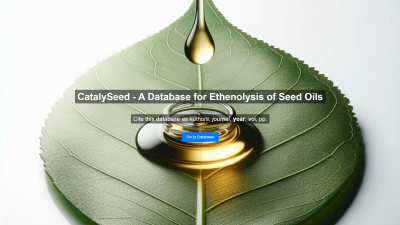
The latest example of the use of these methods in chemistry is a paper published in ACS Catalysis, which was prepared in collaboration between Dr. Juan Pablo Martinez and Prof. Bartosz Trzaskowski from the Chemical and Biological Systems Simulation Laboratory at the Center for New Technologies at the University of Warsaw and chemists from the Universities of Girona and Zaragoza. In this work, a database containing 217 ethenolysis catalysts and 768 different chemical reactions catalyzed by these catalysts was designed and created. Using machine learning methods, the key properties of these catalysts (obtained on the basis of rapid quantum-mechanical calculations) responsible for their high efficiency in ethanolysis were identified. These results show how the CatalySeed database, available through an open and free web server, enables the discovery of non-obvious relationships between the structure and activity of ethanolysis catalysts, supporting catalyst design strategies that go beyond conventional computational approaches. In the future, a similar methodology could be used to design or discover new, more efficient catalysts for any chemical reaction.
More info: https://www.uw.edu.pl/sztuczna-inteligencja-w-sluzbie-katalizy/
The study described in A. Poater, S.P. García-Abellán, J.V. Alegre-Requena, B. Trzaskowski, J.P. Partinez, “CatalySeed: A Reaction Database for Ruthenium-Catalyzed Ethenolysis of Seed Oils with Applications in Machine Learning”, ACS Catalysis, doi: 10.1021/acscatal.5c06483 was funded by the NCN SONATA 19, UMO-2023/51/D/ST4/01561 grant.