


New study reveals an evolutionary bridge in solar energy conversion
22 07 2026
Category: Main page, Research highlights
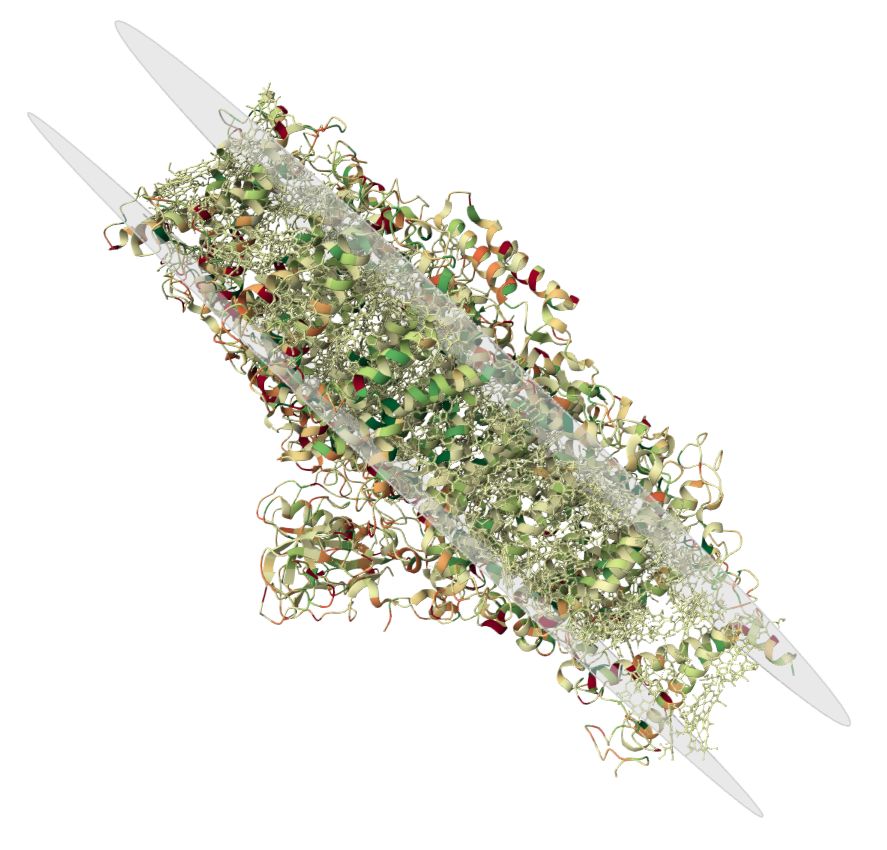
Photosystem I (PSI) converts sunlight into chemical energy with remarkable efficiency, yet how its energy-transfer pathways evolved across cyanobacteria, algae, and plants remain unclear. Using ultralow-temperature two-dimensional electronic spectroscopy combined with quantum dynamics modelling, we show that PSI from the extremophilic red alga Cyanidioschyzon merolae contains two spatially distinct low-energy “sinks” located in both the core and antenna of this biophotocatalyst. Unlike cyanobacteria (core-dominated) or land plants (antenna-dominated), this intermediate architecture re-distributes excitation energy in a temperature-dependent manner while maintaining efficient trapping for optimal energy conversion. Our results reveal how antenna expansion reshaped energy flow during evolution without compromising performance. These insights establish general design principles for balancing efficiency and resilience in natural and artificial light-harvesting systems.
This latest discovery from the Solar Fuels Lab, CeNT UW, was led by Joanna Kargul, with significant contribution of Miriam Izzo and was performed in collaboration with Hong-Guang Duan and Fulu Zheng (Ningbo University) , Ajay Jha (University of Oxford) and R.J. Dwayne Miller (University of Toronto) together with their teams. The work for Solar Fuels Lab team was supported by the National Science Centre, Poland (Solar-driven chemistry grant no. 2022/04/Y/ST4/00107 to J.K.).
Link to the article: https://doi.org/10.1073/pnas.2530661123